Butter and cream.
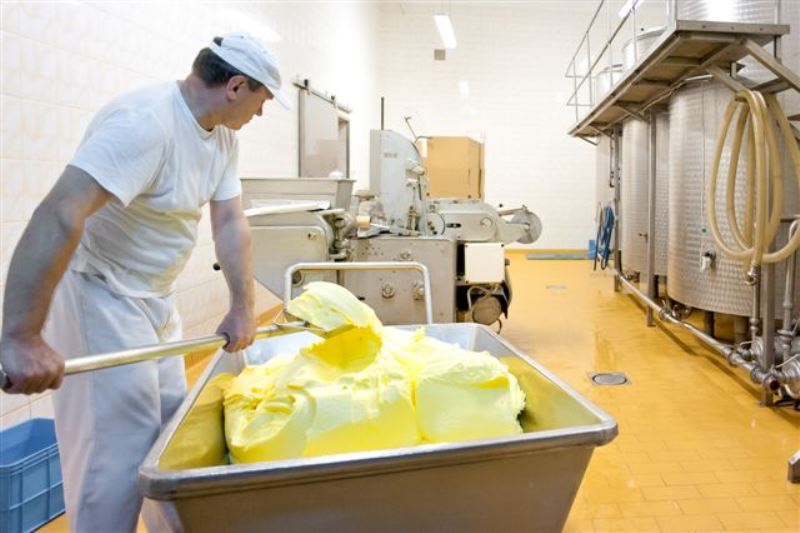
Good butter should contain 82.5-84.2% easily absorbable fat. Currently, we also have butter species on the market, which have a much lower fat content, and higher water content. These butter is not only poorer in fat, but also no more than 70-80% of the carotene contained in milk and about 90% vitamins. About 89-94% carotene and 93— moves to full-gray butter 100% vitamins. Such butter contains 0.8-1.4% of the so -called. dry lean mass, almost all of them, beyond fat, Milk ingredients and certain products of microorganisms in cream and butter. The content of lactose and lactic acid is 0,5% nitrogen substances 0.16-16 - 0.80%, mineral salts 0.1-16%.
Good quality butter should be characteristic, clean, mild, nice, slightly nutty taste and smell. Taken to the mouth should give the impression of a cold.
The durability of the butter depends mainly on the content and distribution of water between fat balls. Higher water content and insufficient dispersion accelerates the spoilage of butter. Sometimes 1-2% of salt is added to increase butter durability. Solation of butter prevents the development of bacteria (In the water phase, the salt concentration is then 6-12%) However, it does not prevent the development of yeast and mold.
Thanks to the specific physicochemical properties, the butter belongs to fats with high dietary value. However, you should take into account, that most fatty acids found in butter are saturated acids. Therefore, the butter cannot replace the fats of plant origin, in which there are many unsaturated fatty acids. EFA.
The butter constituting raw condition with valuable fat with dietetic properties very easily loses its qualities at high temperatures. We do not use butter for frying (except for eggs), because at a temperature above 85 ° C its color changes, taste and smell. The emulsion structure of butter is destroyed, Therefore, its absorption is reduced. Vitamins are oxidized and peroxides are formed, Aldehydes and substances that are harmful to the human system.
Cream has a very large culinary use. The fat content in the most consumed cream is 4-8 times lower than in butter (see butter fat content), However, it provides certain amounts of other ingredients found in milk, i.e.. calcium, Proteins and vitamins of group B.
Craft vegetables poured with cream have a much higher nutritional value and lose much less vitamins in the oxidation process, because the fat contained in the cream protects against the access of atmospheric oxygen. Cream so -called, Sweet has greater irritating properties of the digestive tract than the so -called. acidic.