Margarine
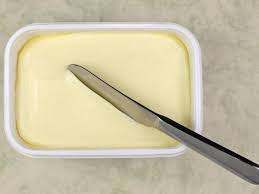
Margarine is fat obtained from hardened and liquid vegetable oils, most often rapeseed, coconut and sunflower. Margarine is an emulsion of these fats with water or milk with the addition of lecithin, dyes, fragrances, soli, vitamins and starch. The addition of starch allows you to detect margarine in butter or other fats (A drop of iodine stains fat to navy blue or blue navy blue color).
The following species of margarine occur in trade:
1. zwykła — emulsja tłuszczów roślinnych z wodą
2. mleczna — emulsja tłuszczów roślinnych z mlekiem
3. deserowa — emulsja tłuszczów roślinnych z mlekiem i dodatkiem witamin i środków aromatycznych
4. masło roślinne — margaryna deserowa z lepszych jakościowo tłuszczów roślinnych z dodatkami upodobniającymi do masła.
Depending on the additives, dessert margarine occurs under the names: Palma, House, and vegetable butter under the name MR, Vita, Nova.
Ceres and oma are also industrial fats. These fats are lard properties. They have no taste or smell. Ceres is hard brittle, More vividly thanks to the addition of liquid oil under the homogeneis.
It is worth saying that neither butter nor margarine should be used for frying. We add these fats to raw dishes. We use margarine for baking cakes and thickening of dishes, and also for frying eggs. When using vegetable oils for frying, we should never exceed 180 ° C!, Due to the possibility of fat breakdown, What is most often known to know the so -called. The fat that began to smoke, We are commissioning from the pan (nie wystarczy sama regulacja temperatury) And after careful washing the pan, we pour new fat.