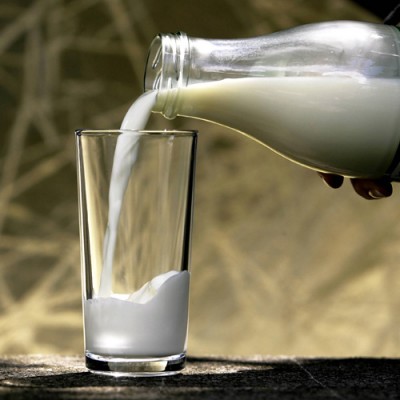
 The milk consists of almost all nutrients needed both for the growth of the young body, as well as to maintain his physical fitness. Due to the appropriate proportions between individual groups of nutrients, milk is a product with exceptional nutritional value.
Milk is consumed in the form of various milk drinks, cottage cheese and rennet, cream, powdered milk, And above all, it is a component of many dishes. Energy value 1 l full milk ranges within 2303-2931 KJ (550—700 kcal), Depending on the amount of fat. 1 l milk contains OK. 31 g of full -fledged protein. Milk should be included in low -calorie products, having valuable dietary properties.
Due to the high content of the necessary amino acids, The milk protein matches the biological value of egg and meat protein, and at the same time it is 2-3 times cheaper than him. Especially the content of lysine (ok. 2,6 g/l, with the daily human demand 1,6 g) and methionine content (0,93 g/l) the trlyptoff (0,43 g/l) and other exogenous amino acids make milk protein a very valuable ingredient in food. The content of the necessary amino acids is different in various protein fractions, np. in casein they constitute 45,9 g/100 g protein, And in whey proteins 52,7 g/100 g protein, that is, the most favorable is to consume milk as a whole.
Milk fat occurs in a state of strong dispersion in the form of an emulsion, in which the balls of fat are covered with a thin protein shell. Large dispersion of fat and bowl of melting (28—33°C) facilitate its absorption, especially in children and sick people.
Covering the demand for some nutrients in a child
and an adult man by 0,5 l milk
|
Nutrients |
A child aged 2-6 % |
Man % |
|
Energy value |
22 |
11 |
|
Protein |
31 |
20 |
|
Iron |
2 |
1 |
|
Calcium |
60 |
76 |
|
Vitamin A (in fat) |
22 |
14 |
|
Vitamin D (in fat) |
3 |
— |
|
Thiamine B1 |
35 |
18 |
|
Nicotine acid |
7 |
4 |
|
Ryboflawina b2 |
87 |
44 |
Milk is a good source of many vitamins, np. 1 l full milk can satisfy a large part of the demand for vitamin A, B1, B2, B12 and pantothenic acid.
Milk is the main source of riboflavin, whose action on the human body is multilateral. Among other things, it supports the liver in excreting toxic substances from the body.
Milk contains very important minerals for humans, First of all, calcium and phosphorus. About 50% ash is calcium and potassium, thanks to which the milk deacidifying the human body, which is very important with unilateral nutrition with cereal products.
Milk contains a certain amount of immune substances (antibodies). They usually occur in the globulin fraction, like euglououlin and pseudoglobulin, which are OK. 10°/with a total amount of globulins.